Warm up:
Function Machines
(Care of www.mathsgenie.co.uk)
Function Machines Video
Practice Questions
Textbook Exercise
(Care of corbettmaths.com)
Describing functions:
A function is a mathematical description, rule or law, between variables. Functions take an input value, i.e., and converts it into an output value .
- Examples:
- ;
- ;
Note, the notation is read "f of x".
Example 1:
If , then find , , and .
Solution:
Example 2:
If , then find , , and .
Solution:
Example 3:
If h(x) = x² - 3x, then find h(x) = 10, h(x) = -2, h(x) = 0.
Solution:
h(x) = 10
x² - 3x = 10
x² - 3x - 10 = 0
(x - 5)(x + 2) = 0
x = {-2, 5}
h(x) = -2
x² - 3x = -2
x² - 3x + 2 = 0
(x - 1)(x - 2) = 0
x = {1, 2}
h(x) = 0
x² - 3x = 0
x(x - 3) = 0
x = {0, 3}
Example 4:
If g(x) = tan x, then find g(x) = 1.
Solution:
g(x) = 1
tan x = 1
x = arctan 1
x = pi/4 + pim where .
Questions:
Care of mmerevise.co.uk
Further Materials
Inverse Functions
To find the inverse of a function, a graphical or algebraic method can be used. Graphically the inverse function can be found by reflecting the function in . Note: the domain and range are swopped with either method.
To find the inverse function, algebraically we follow this procedure:
- replace with ;
- rearrange this equation to make the subject;
- then replace with and with .
Examples:
Let then
Replacing with and with for we get
- from corbettmaths.com:
- Inverse Functions video
- Practice Questions
- Textbook Exercise
- Further Reading:
- from mathsisfun.com
- from math.net
- from wikipedia.org
- Notes:
- The substitution of with is just to make it easier to rearrange in step 2.
Function & Graph Transformations
|
moves the function up by
moves the function down by |
|
|
moves the function left by
moves the function right by |
|
|
stretches the function in the y-direction by scale factor
compresses the function in the y-direction by scale factor |
|
|
compresses the function in the x-direction by scale factor
stretches the function in the x-direction by scale factor |
|
| Reflects the function about x-axis | |
| Reflects the function about y-axis | |
| to give | by reflection in |
Function & Graph Transformations
from mathsisfun.com
Tranformation of Functions
from www.cuemath.com
Tranformation of Functions
from alevelmaths.co.uk
... search for more ...
(Care of duckduckgo.com)
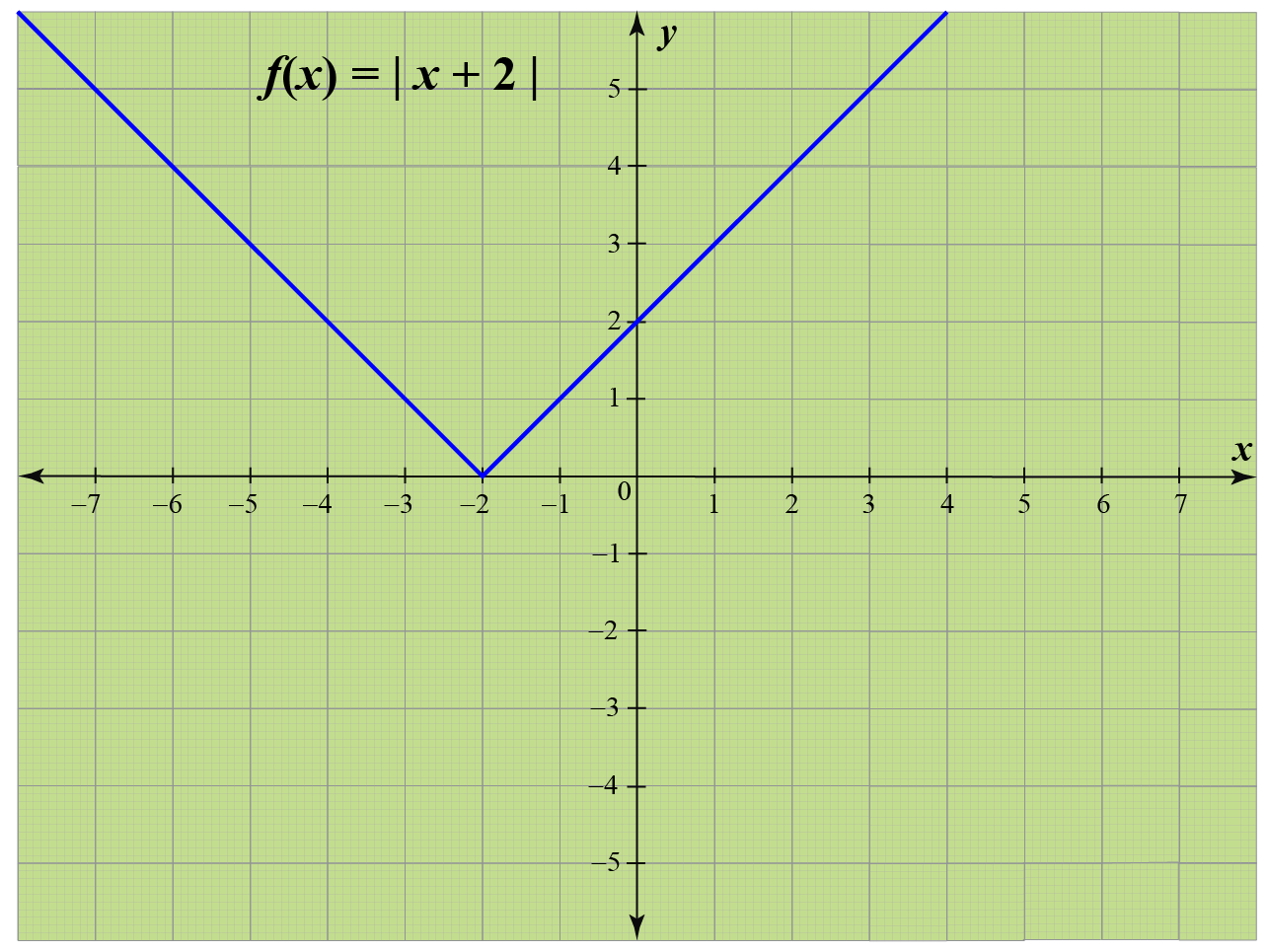
Modulus Function
Notes and Videos
Questions
(Care of mathsmadeeasy.co.uk)
from mkhometuition.co.uk
Exam Questions (pdf)
(care of alevelmathsrevision.com)
find more at duckduckgo.com
Composite Functions
Prerequisite Material:
Composite Functions:
Definition: a function made of up of two or more other functions, where the output of one is the input to the other and so on.
Example:
If
,
then
.
We could take this output and enter it into another function, say,
.
Entering the value from , then
.
The same result can be found by substituting into
So, if then
.
That is the same as before.
An alternate way of writing
can be written as
.
Note: the function is worked out before .
In general is not the same as .
Inverse functions have the following property:
Questions:
Practice Questions
from corbettmaths.com
Textbook Questions
from corbettmaths.com
GCSE Questions & Answers
from piacademy.co.uk
Further Maths Video
from corbettmaths.com
Further Maths Practice Questions
from corbettmaths.com
Further Reading:
Domain and Range

Domain for the above is ,
and the range is .