| Name | Symbol | Quantity | Equivalents | SI base unit equivalents |
|---|---|---|---|---|
| becquerel | radioactivity | |||
| coulomb | electric charge | |||
| farad | electrical capacitance | |||
| gray | Gy | absorbed dose of ionizing radiation | J/kg | m2s-2 |
| hertz | Hz | frequency | ||
| joule | energy, work-done, heat | |||
| katal | catalytic activity | |||
| newton | N | force | ||
| ohm | Ω | electrical resistance | ||
| pascal | pressure, stress, youngs modulus | |||
| radian | rad | angle | 1 | |
| sievert | Sv | equivalent dose of ionizing radiation | J/kg | m2s-2 |
| tesla | T | magnetic flux density, magnetic field strength | Vs/m2, Wb/m2, N/(Am) | kgs-2A-1 |
| volt | ||||
| watt | power, radiant flux | , | ||
| weber | magnetic flux |
A fuller list of SI derived units can be found at en.wikipedia.org.
Angle and Measures of Angle
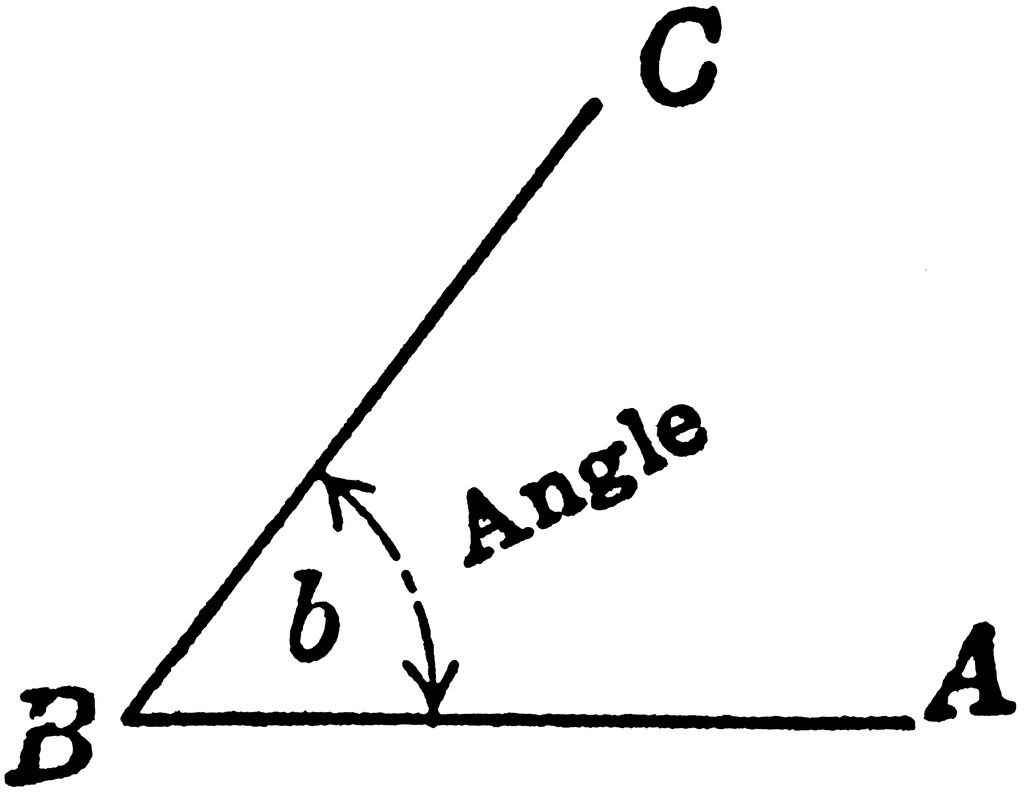
An angle is the figure formed by two rays, called the sides of the angle, sharing a common endpoint, called the vertex of the angle. Angles formed by two rays lie in the plane that contains the two rays. Angles are also formed by the intersection of two planes. These are called dihedral angles. Two intersecting curves may also define an angle, which is the angle of the rays lying tangent to the respective curves at their point of intersection. Angle is also used to designate the measure of an angle or of a rotation. This measure is the ratio of the length of a circular arc to its radius. In the case of a geometric angle, the arc is centred at the vertex and delimited by the sides. In the case of a rotation, the arc is centred at the centre of the rotation and delimited by any other point and its image by the rotation. (scrapped from https://en.wikipedia.org/wiki/Angle) Further reading at skillsyouneed.com
A definition of Angle:
The arc length equation can be rearranged to make the angle, , to be the subject:
Here the angle is measured in degrees and the equation implies that the angle is proportional to the ratio which means we can write;
Taking the constant of proportionality to be one and where is the angle in radians.
Radians are not used in everyday life and, sometimes, within science, technology, engineering, and mathematics (STEM), radians have been found to be far more "natural" in STEM.
Angles measured in degrees and radians are related thus:
Radians vs Degrees
Conversion between some frequently used angles are:
| Turn | θ / ° | φ / radians |
|---|---|---|
| 0 | 0 | 0 |
| 30 | ||
| 45 | ||
| 60 | ||
| 90 | ||
| 180 | ||
| 270 | ||
| 1 | 360 |
More generally we can use these expressions to convert between one another:

Conversion from one to the other

... and other measures
of angle.
- Questions:
- Radians [ MS ];
- Small Angle Approximations [ MS ].
Further reading/study
Small Angle Approximation
Inscribed Angle
Beyond Angle Alone
Double Angle Formulae
Interior and exterior angles
Conversion between Squared Measures
and Cubed Measures
The following gives a proof for the conversion of area and volume units. Before proceeding ensure you are familiar with the following ...
- SI Units
- Area Calculations (Care of revisionmaths.com)
- Volume Calculations (Care of revisionmaths.com)
Lengths
1m length is the same as

Areas
Now, for a square of side we have ...

The area of this square is ...
But we can also calculate the area by ...
So, ....
Volumes
Now, for a cube of side 1m we have ...

The volume of this cube is ...
But we can also calculate the volume by ...
So, ....
Questions:
- Converting Areas Video
- Practice Questions
- Textbook Exercise
- Converting Volumes Video
- Practice Questions
- Textbook Exercise